You’re changing how you charge for creativity. Is your culture changing with it?
“Final push.” “Let’s finish on a high.” “We’ll all get a proper break at Christmas.”
If we had a Pound for every time we have heard those lines, we would have a very generous Christmas party budget!
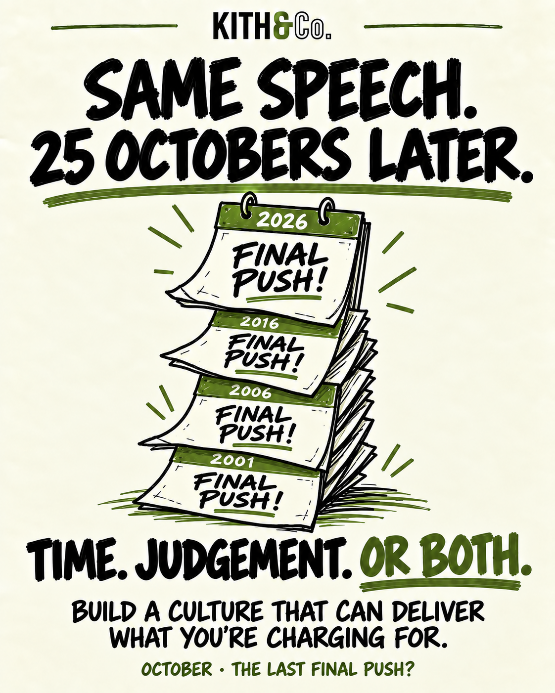
If you have spent any time in a creative business, as we have, you know the October speech. Ask anyone who started as a junior twenty-five years ago what Q4 felt like in their first job, then ask what it feels like now. The software has changed beyond recognition. So have the offices, the channels, the clients and quite possibly the coffee. The final push sounds remarkably familiar.
That is a curious thing for an industry that redesigns brands, products and entire categories for a living. We have reinvented almost everything except the way we carry our busiest, and possibly most complex, quarter.
Our view is that Q4 was never really a season. It is a business model showing its seams. Q4 is when the year’s number gets made, and when the number is built on hours, the push is made of hours. This year, for the first time in a long while, the model is moving.
The Last Final Push?
The commercial conversation has started. Finally.
For decades, much of the industry sold time. Independents have been experimenting with alternatives for a while. One agency founder said to us recently that the winners will be the agencies that connect AI to great human work, so clients reach senior people who finally have time to solve their problems.
Now the giants are following. This year, one of the world’s largest advertising groups said it intends to move away from “time and materials” towards pay linked to client outcomes . When the biggest names follow the independents, the change is usually here to stay. AI is speeding it along: when a first draft takes minutes, billing by the hour starts to penalise the businesses that work well.
New commercial models are not new cultural models
Here is the catch. You can change how you invoice in a quarter. Changing what your culture rewards takes longer. Change the price tag without changing the culture and you have simply rebranded the timesheet. A fixed fee with a fuzzy scope can still run on endless revisions and late evenings. An outcome-based fee inside a culture that applauds visible exhaustion produces the same October with nicer spreadsheets.
The technology story points the same way. Gartner found only 22% of large organisations had scaled AI across multiple business units or gone AI-first, and MIT’s Project NANDA traced the missing return from much enterprise AI to a “learning gap” in systems and workflows. Neither looked at creative businesses. Our interpretation, and we own it: a tool that does not learn wastes its potential, and so does an organisation.
The Last Final Push?
Time, judgement or both? Make it true.
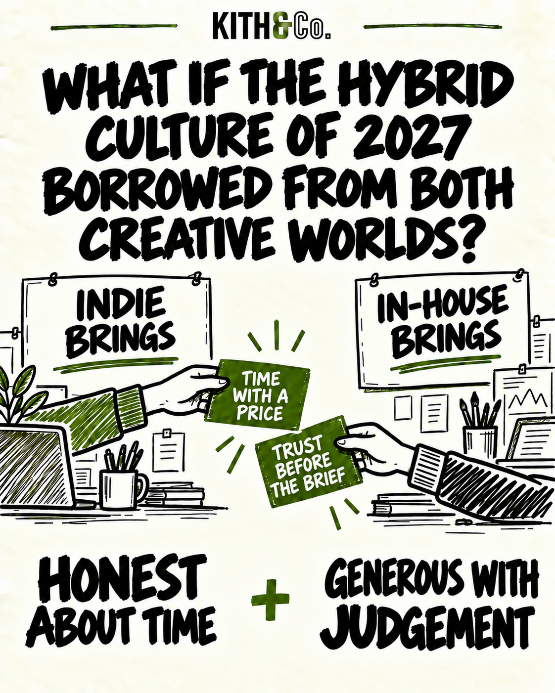
Not every client will want to buy judgement. Plenty will keep buying time, and that is perfectly fine. Most independents in 2027 will sell some of each. The useful question is whether your culture makes your model true.
If you sell time, the culture’s job is to make the time honest: real hours recorded, urgency priced or pushed back on, no evenings quietly absorbed. Thom Binding, co-founder of the Creative Communications Union, told Campaign that agency workers are “culturally pressured to submit timesheets in line with the cost estimate, not the actual work reality”
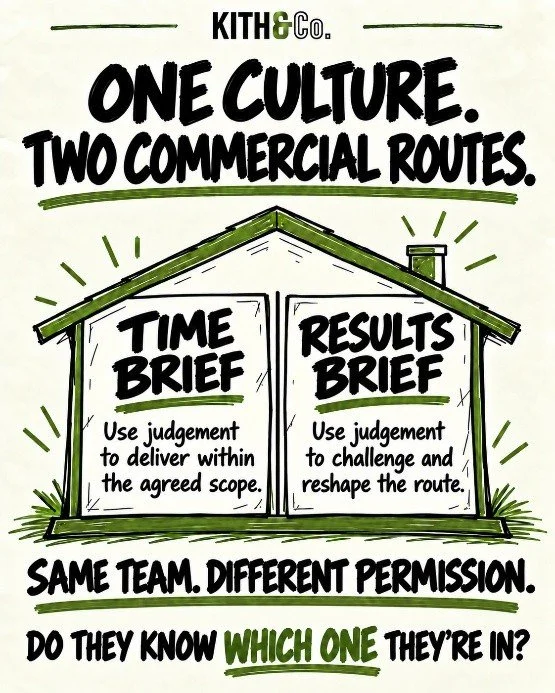
If you sell judgement, the culture’s job is to let judgement actually be used. Expertise that has to queue behind three approvals is not what the client paid for. And if you sell both, the risk is running two cultures under one roof: one team trusted to decide, the other told to log it and keep quiet.
In practice, the switch will happen brief by brief, sometimes for the same client in the same week. The banner resize is billed by the hour; the Christmas campaign is paid on results. The cultures that thrive will name the deal at the kick-off, so people know which game they are playing and bring the right behaviours to it. Know what you are selling before you start.
In-house creative teams offer a useful preview. Most are not paid by the hour: in the In-House Agency Leaders Club’s 2023 benchmarking survey of around 50 in-house agencies, 69% did not charge the business for their work at all. Yet their biggest barrier to better work was lack of time and planning ahead. When time stops being priced, it has to be protected, or it becomes everybody’s. Losing the timesheet is the easy part.
Whatever you invoice for, your culture has to make it true.
The Final Last Push?
If you sell judgement: five signs your culture is ready
In August we explored how judgement is developed. October asks what happens once it is what you sell. And last month we said AI cannot decide who your saved time belongs to. Q4 is when somebody decides anyway, usually by Thursday.
People feel safe enough to say “this is too much” or “this brief is wrong” early, while it is still cheap to hear.
Expertise comes with the authority to use it, to challenge a brief or shape the scope within clear boundaries.
Time is flexible, but never invisible. People have the autonomy to work when their judgement is strongest, freed capacity has an owner, and hours, boundaries and recovery stay honest.
Reviews make space for unfinished thinking, with someone clearly responsible for the decision.
And recognition follows craft: the quality of the call and its impact on the client, alongside the hours and the deadlines.
The Judgement Dividend
Which brings us to the question almost nobody is asking. Your invoice now says “judgement”. Your payslip still says “37.5 hours”.
The real week often runs longer. The TUC estimates that around 3.5 million UK employees did unpaid overtime in 2025, averaging 6.8 hours a week. In creative businesses, those unrecorded hours often carry the thinking clients value most. And the people joining the industry have noticed: in Deloitte’s 2026 Gen Z and Millennial Survey, Gen Z’s most cited work stresses were long hours (51%) and not feeling recognised or rewarded (47%).
The answer is not more hours. Creative judgement rarely arrives neatly between nine and five, so a business selling judgement may need to trust people to shape their time around when they think best. Some agencies are already trying patterns like 10am to 2pm, then 8pm to midnight: the same hours, arranged differently. Flexibility only counts if the hours stay honest. Otherwise it is overtime in a nicer outfit.
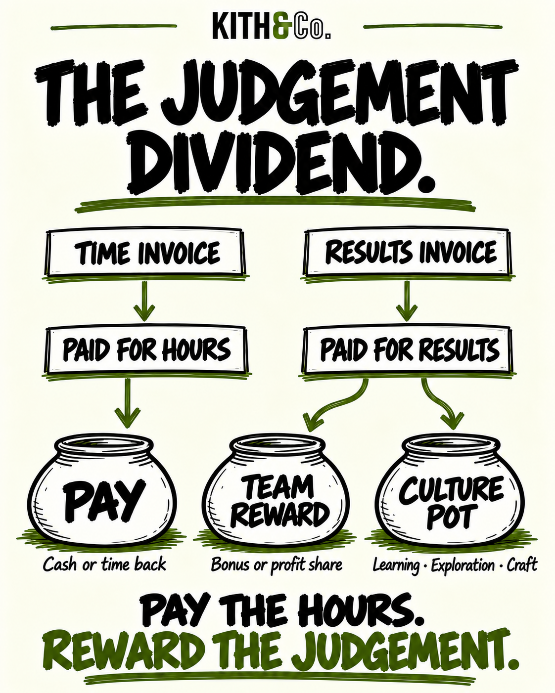
So here is our provocation. Honest hours. Trusted judgement. Pay the hours properly, in cash or in time back, and give people real control over when they use them. When work sold on judgement creates value beyond its cost, share part of it: a modest team bonus, and a pot reinvested in the craft itself, in learning, exploration time and development. We call it the Judgement Dividend.
It is less far-fetched than it sounds. A 2020 meta-analysis of 56 studies found profit sharing is positively linked to productivity, most strongly where employees also take part in decisions. Around 2,470 UK businesses are now employee-owned , creative agencies among them. What we have not yet seen is a business ring-fencing the fruits of judgement to grow more of it. Yet.
One pot, shared by everyone, including the people on hours-based briefs. That is how a hybrid business stays one culture. It is also Strategic Joy in its most literal form: effort, value and reward finally pointing in the same direction.
The Last Final Push?
Ask first, then design
Pick one project from this quarter and follow it with the team. Where did experience improve the outcome? Where was expertise wasted? Where did the saved time go? What would everyone change? Those answers are the first lines of your 2027 design, and October is early enough to write them.
Where to start
A Culture Intelligence Audit helps our Culture Architects read what your culture is teaching people at every level. Culture Architecture then designs the decision rights, ways of working and reward principles that let a creative business sell its craft, by the hour or by the idea, without spending its people.
High performance in 2027 will look different. Fewer heroics. More judgement. Honest time. A business that makes ever better use of its people’s craft, and keeps growing their capacity to do even better work.
Twenty-five years of final pushes is plenty. Let’s make this one the last of its kind.
If this is landing, let’s talk.
Book a conversation: alex.sanz@kithandco.uk / lisa.berardi@kithandco.uk